Research
My research combines ecology, geochemistry, and quantitative approaches to understand animal movement, life-history diversity, and population connectivity.
Active funding
Current externally funded research projects as Principal Investigator, Co-Principal Investigator, or project partner.
Research projects
Insights from Atlantic salmon scale archives
Digitizing Norwegian salmon scale collections and developing automated image-analysis workflows for long-term monitoring.Read more
Insights from Atlantic salmon scale archives
Norwegian salmon monitoring has produced large scale archives that contain long-term information on age, growth, and origin. This project focuses on digitizing these collections and making archived scale images easier to analyze and reuse.
Recent work used nearly 90,000 scale images from national archives to develop a deep-learning model for identifying escaped farmed salmon. Ongoing work is extending digital workflows for scale interpretation and measurement while retaining the value of the original long-term collections.
Sturgeon life histories and harmful algal blooms
Using fin-ray geochemistry and age structure to examine whether Green and White Sturgeon life histories differed in vulnerability to the 2022 San Francisco Estuary harmful algal bloom.Read more
Sturgeon life histories and harmful algal blooms
The 2022 harmful algal bloom in the San Francisco Estuary caused extensive fish mortality, including large numbers of Green and White Sturgeon. Pectoral fin rays preserve annual growth increments and geochemical records that can be used to reconstruct age and long-term habitat use.
This project compares sturgeon collected during the bloom with fish from other periods to examine age structure and migratory histories. The analysis tests whether particular age groups or habitat-use patterns were disproportionately represented among fish affected by the event.
Central Valley Steelhead life histories
Using otolith-based age and geochemical reconstructions to quantify demographic and migratory diversity in California Central Valley Steelhead.Read more
Central Valley Steelhead life histories
California Central Valley Steelhead (Oncorhynchus mykiss) express considerable variation in age, growth, migration timing, and freshwater residence. Quantifying this diversity is important for understanding population structure and how different life histories contribute to the remaining anadromous population.
This project uses otolith-based age estimates and geochemical profiles to reconstruct individual life histories from returning adults. By combining information on age, growth, and freshwater-to-marine transitions, we aim to describe the range and frequency of steelhead life-history strategies across the Central Valley and how these vary among populations and years.
Non-lethal geochemistry from Steelhead scales
Developing geochemical methods to reconstruct natal origin and anadromy from fish scales as a non-lethal alternative to otolith analysis.Read more
Non-lethal geochemistry from Steelhead scales
Otolith chemistry can provide detailed information on natal origin and migration history, but otolith collection requires sacrificing the fish. Scales offer a non-lethal archive that can be sampled from living fish and potentially used to recover some of the same life-history information.
This project develops and validates geochemical approaches for reconstructing natal origin and anadromy from Oncorhynchus mykiss scales. The work focuses on how faithfully scale chemistry records environmental signatures and how these measurements can be incorporated into monitoring programs where non-lethal sampling is important.
Pink salmon origins in the North Atlantic
Using otolith geochemistry and scale analyses to examine the origins, local production, and life histories of pink salmon expanding across the North Atlantic.Read more
Pink salmon origins in the North Atlantic
Pink salmon (Oncorhynchus gorbuscha) now occur well beyond their established range in the Barents and White Sea region, including rivers in Iceland. A key question is whether adults returning to these rivers were produced locally or are immigrants from elsewhere in the North Atlantic.
The current Iceland project uses otolith 87Sr/86Sr to test whether returning adults carry natal signatures consistent with Icelandic rivers. Complementary scale analyses examine variation in marine growth and body size among regions and years.
Norwegian strontium isoscape
Compiling and modelling surface-water strontium isotope data to build a national isoscape for provenance studies in Norway.Read more
Norwegian strontium isoscape
Strontium isotope ratios vary across landscapes and can be used to trace geographic origin in both ecological and archaeological studies. In Norway, available water data are distributed across published studies, reports, and other sources, but have not yet been assembled into a consistent national baseline.
This project compiles surface-water 87Sr/86Sr data from rivers and lakes across Norway and uses these records to develop a predictive isoscape. The aim is to provide a spatial reference framework for provenance applications and to improve understanding of how geology and environmental factors shape isotopic variation at a national scale.
Salmon at their range edge
Understanding the origins, reproduction, and potential establishment of Chinook Salmon at the southern edge of their current range.Read more
Salmon at their range edge

Chinook Salmon are regularly observed spawning in the Guadalupe River, an urban tributary at the southern end of San Francisco Bay.
This project combines long-term community observations with coded-wire tags, genetic assignment, eye-lens stable isotopes, and otolith strontium isotope analysis to distinguish hatchery strays, natural-origin fish, and possible locally produced adults.
The broader goal is to develop a framework for evaluating salmon population establishment where monitoring data are incomplete and multiple lines of evidence carry different levels of uncertainty.
Juvenile Chinook Salmon growthscapes
Reconstructing juvenile Chinook Salmon growth from otolith biochronologies to compare growth opportunities across Central Valley rearing habitats.Read more
Juvenile Chinook Salmon growthscapes
Juvenile Chinook Salmon move through river, floodplain, and bypass habitats where growth conditions can vary strongly through space and time. Otolith growth increments provide a way to reconstruct individual size and growth trajectories after fish have left these habitats.
Building on experimental validation of otolith-based growth reconstructions, this project compares juvenile growth across Central Valley rearing grounds and environmental conditions. The aim is to better describe when and where different habitats provide favorable growth opportunities and how those patterns vary among years.
Ancient salmon and long-term ecological baselines
Using archaeological salmon remains to reconstruct long-term changes in Chinook Salmon age structure and life-history diversity in California.Read more
Ancient salmon and long-term ecological baselines
Modern monitoring provides only a short window into the life-history diversity of California Chinook Salmon. Archaeological fish remains provide a much longer record and can be used to place recent changes in a historical context.
Working with archaeological otoliths from the Feather River watershed, we reconstructed salmon return ages across several time periods spanning roughly four millennia. Current work continues to explore how archaeological and historical archives can provide ecological baselines for interpreting changes in salmon populations.
Salmon establishment in Putah Creek
Using otolith geochemistry, age structure, and long-term monitoring to understand how Chinook Salmon colonize restored habitat and establish new populations.Read more
Salmon establishment in Putah Creek
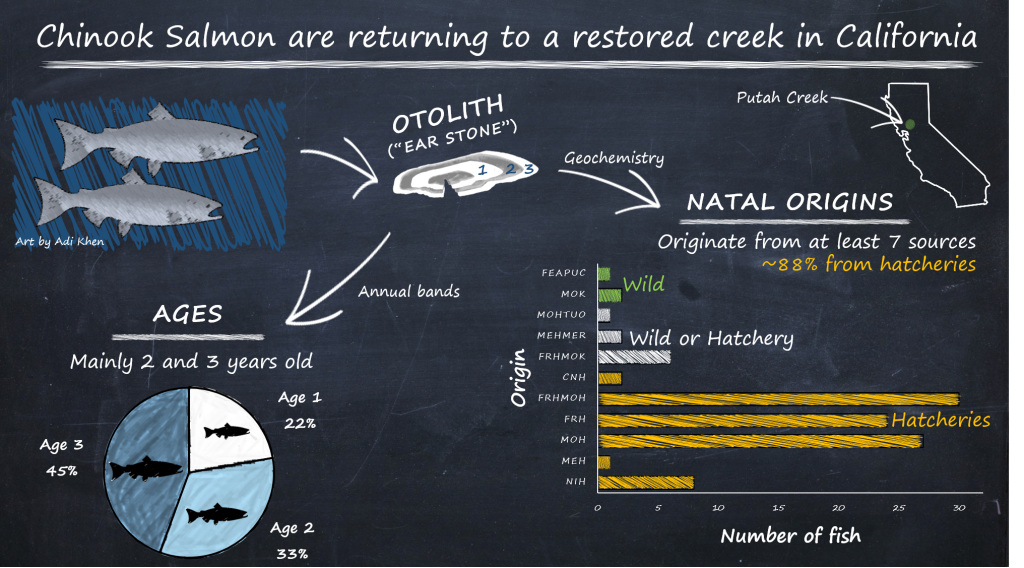
Salmon in Putah Creek
Lower Putah Creek is a small, highly modified stream in California’s Central Valley that flows from Lake Berryessa through the town of Winters and past the UC Davis campus before entering the Yolo Bypass. Following restoration of a more natural flow regime, adult Chinook Salmon (Oncorhynchus tshawytscha) began returning regularly to the creek, accompanied by observations of spawning and juvenile production.
We use otoliths collected from adult salmon carcasses to reconstruct the age and natal origins of fish spawning in Putah Creek. Otoliths form continuous growth increments throughout a fish’s life and preserve chemical signatures of the environments it occupied. In particular, spatial variation in 87Sr/86Sr among Central Valley rivers and hatcheries allows us to distinguish among potential natal sources and reconstruct the origins of returning adults.
Our initial work showed that salmon spawning in Putah Creek originated from multiple locations throughout California’s Central Valley and were dominated by hatchery-origin strays. These results demonstrated how dispersing fall-run Chinook Salmon can rapidly colonize newly restored habitat.
Continued monitoring across subsequent spawning years provided evidence for the next stage of population establishment. By combining otolith 87Sr/86Sr, trace-element chemistry, coded-wire tags, age estimates, and juvenile monitoring, we identified adults whose chemical signatures were consistent with natal origin in Putah Creek. These fish provide evidence that salmon can successfully reproduce in the restored watershed, survive juvenile outmigration and the marine phase, and return as adults to spawn.
Putah Creek therefore provides a valuable natural experiment for understanding how salmon populations form in restored and previously underutilized habitats. The project highlights the interaction between straying, hatchery supplementation, habitat restoration, and natal homing during the early stages of population establishment.
Further reading
Willmes M. et al. (2021). Geochemical Tools Identify the Origins of Chinook Salmon Returning to a Restored Creek. Fisheries 46:22–32.
Hitt L.G. et al. (2025). Early evidence for establishment of a Chinook salmon population in a restored watershed. Ecosphere 16:e70207.
Thermal life histories of Delta Smelt
Using strontium and oxygen isotope profiles in archived Delta Smelt otoliths to reconstruct salinity history, thermal exposure, and habitat use in the Sacramento–San Joaquin Delta.Read more
Thermal life histories of Delta Smelt
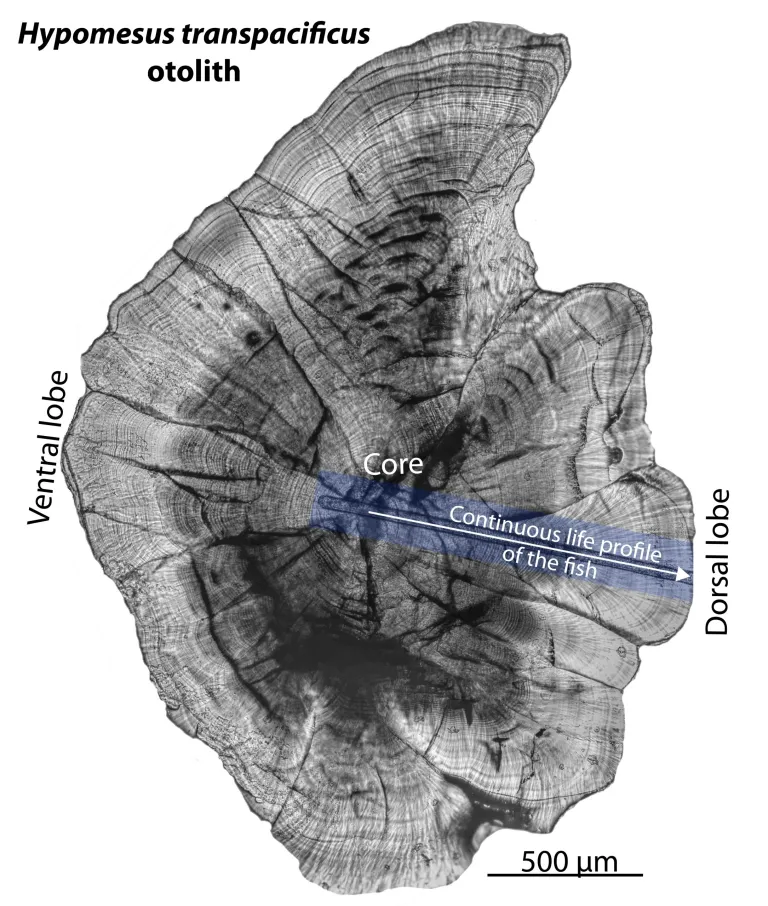
In search of refuge
Delta Smelt (Hypomesus transpacificus) is a small pelagic fish endemic to the Sacramento–San Joaquin Bay-Delta and one of the most imperiled fishes in the San Francisco Estuary. Its habitat lies within a highly managed estuary where freshwater flows, water exports, drought, and increasing temperatures interact to shape available habitat.
During my 2017–2019 Delta Science Fellowship, we used strontium isotope ratios (87Sr/86Sr) and oxygen isotopes (δ18O) measured along archived Delta Smelt otoliths to reconstruct individual life histories at fine temporal scales.
Otolith 87Sr/86Sr ratios provide information about the salinity and geographic environments occupied by a fish, while otolith δ18O records variation associated with water temperature. Combining these tracers allows movement among habitats to be evaluated together with the thermal conditions experienced by individual fish.
The project investigated how Delta Smelt habitat use and thermal exposure varied in relation to freshwater outflow and environmental conditions, with particular interest in drought periods and warming water temperatures. The broader goal was to improve understanding of the habitats that may provide thermal refuge and contribute to the resilience of Delta Smelt under climate change.